Album Review: DomJord – Morgonglöd: Laus Industria, Cunabula Ardens Exitii – Part I

Artist: DomJord
Album: Morgonglöd: Laus Industria, Cunabula Ardens Exitii – Part I
Label: Norma Evangelium Diaboli
Release date: March 27th, 2026
Country: Sweden
Format reviewed: High-quality digital recording
Album Review: DomJord – Morgonglöd: Laus Industria, Cunabula Ardens Exitii – Part I via Norma Evangelium Diaboli by Ioana
I don’t think there’s ever been an album which I ended up reviewing that felt as daunting as this one right here. It is very much an experience to just listen to it, writing about it is a whole other story in of itself. All that being said, I could have perhaps delayed doing this review until I ended up getting my hands on a CD of the album, but given that I have no certain time frame in which that will happen, the odds ended up leaning in favor of me engaging in the otherwise redundant endeavor of writing about an album that speaks for itself. But at the same time, it is also one piece of music that I had greatly been looking forward to diving into. That being said, paradox of intent aside, I might as well get to the point.
For those unaware, DomJord is the ambient/electronic music project of Marduk frontman and Funeral Mist mastermind Daniel Rostén, for which he has put out three albums thus far, Sporer, Gravrost, and the latest one, Morgonglöd, which is, of course, the topic of this review. According to a Bardo Methodology interview conducted back in 2020, upon the release of Sporer, the project was described as a sort of musical venture, initially meant to remain private, or perhaps, a one off endeavor ( “DomJord is an all-electronic project I’ve been working on for some time now. As everyone knows, certain situations call for certain music and certain moods call for certain tunes; having long searched for this specific type of sound without ever really finding anything even remotely close to what I had in mind, I simply decided to make it myself. The original plan – if there ever was one – was to just keep the music for myself and bring it out whenever this particular void needed filling. However, the musician in me felt otherwise and couldn’t just leave it at that. It had to be released, if not to reach out to a supposed listenership with the same or similar needs then at least to put an end to a chapter and move on.” – Daniel Rostén). He also went on to describe DomJord as “the complete opposite of everything I’ve ever released, performed, or taken part of before”, which, when looking at Sporer and Gravrost, makes perfect sense. Both albums feature soundscapes which are simultaneously expansive and minimalistic, full of textures and faint melodies which evoke a sense of familiar calmness, which may even come off as dreamlike-at times. This is particularly noticeable on Gravrost, at least to my ears. All these elements are continued on Morgonglöd, however, not in a typical manner. And I would argue this is where things get truly interesting, not only musically, but also conceptually.
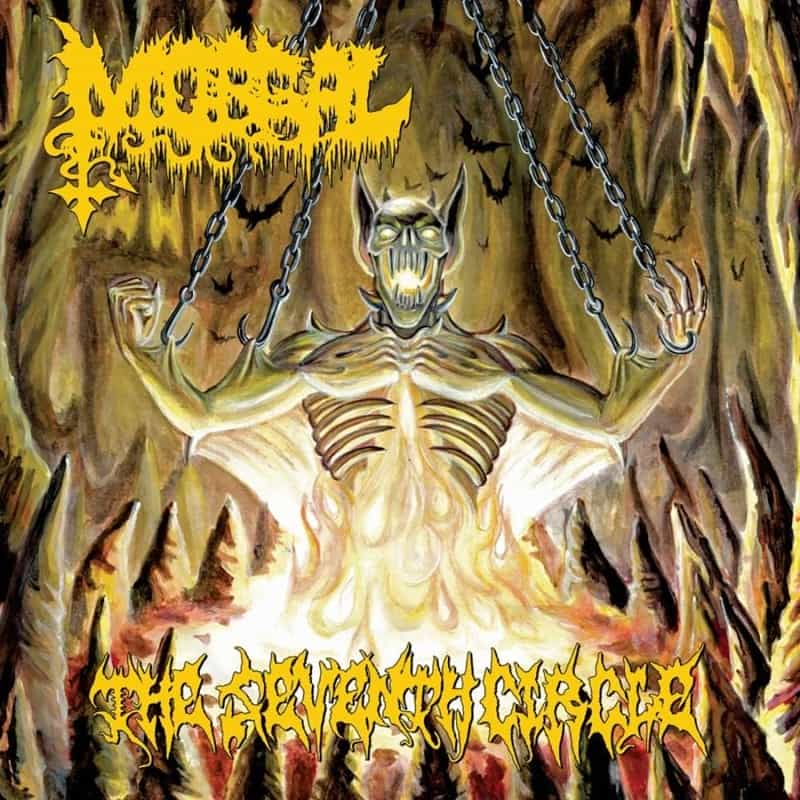
Morgonglödis, to my ears at least, the album where the concept of DomJord crystalized, so to say. Where Sporerstrikes me as an “ode to nature” piece and Gravrost is a more introspective reflection on Rostén’s own surrounding environment, a musical journey through “ominous landscapes of rust-laden ruins, barren ground, and the thick black fog of burning oil”, Morgonglödtakes that and adds a conceptual framework which is then used to create a much more fleshed out piece of music. This conceptual framework, is, once again, best described by the man himself, in the form of a phrase which accompanies the album: “If the final collapse is to be man-made, the Industrial Revolution may be deemed the cradle. This is my attempt at its soundtrack.”. That more or less leaves the listener dealing with an album which takes the landscape at the core of Gravrost and the states that come with it, and scales it up to apocalyptic dimensions and offering it existential gravitas. This is also one of the things that surprised me right off the bat about Morgonglöd, not because the conceptual direction is unnatural, it very much is, but more so because of the fact that a new DomJord album was the last thing I would have expected to show up. Add to that the amount of doomy-ness present on the record and it’s easy to see why it got my gears blocked for a good amount of time. The album cover is also strikingly different from the types of covers seen before on DomJord albums, being not only more complex but also more symbolically dense, to the point where, as I was waiting for the album to be out, I was wondering whether it would have hints of martial industrial or anything similar.
Onto the music itself though… I believe this album is best discussed track-by track, since diving into the music altogether would lead to even more nuance being lost than it already is, inevitably (something that’s being made more and more clear to me day by day is that one is, after all, incapable of truly capturing the essence of music in a text description). In the case of this album, the analyses I can offer regarding the songs are merely vague impressions on what one is actually capable of hearing. All that being said, here comes the actual music:
The album opens up with “Kol” (or “Coal” in English), and it is very much the type of album opener that leaves a strong impression on the listener right from the first couple of notes. The main synth layer has a slow, percussive pace, and it is placed somewhere in between the middle and lower register, featuring a serious amount of distortion. This results in a sound which is both sharp and grand, which creates that sensation of the music hitting you in the chest. The second main layer is comprised out on a less harsh type of synth effect, also placed in the mid-to-low register, which is where the main melodic patterns are being showcased. This layer is often met with harmonies played in higher registers, or very faint reproductions of the musical ideas, played in different parts of the soundscape, thus creating a sensation of both openness and pressure. The melodies themselves never fully resolve, existing more as musical tokens than fully fleshed-out structures. They are rather melancholic and contemplative in tone, several bearing similarities to the song“Into Ashes” from Funeral Mist’s latest album, “Deiform” in terms of both structure and the intervals between the notes. For some reason, which I have found myself unable to identify, there is something oddly comforting about this song, similar to that sensation of familiarity I described in the case of Gravrost.
“Eld” (“Fire”), comes up next, and the greatest change it brings along in the soundscape is the introduction of throat singing. Now, there’s been instances of throat singing in DomJord’s music before (on Sporer, for example), but due to me being more or less oblivious, I always thought those were samples. Spoiler alert, they aren’t. This is made very clear on this track, through Rostén’s decision of adding these particularly interesting vocal effects at the end of each phrase, which consist of these rather abrupt shifts between the typical throat singing technique and something very close to his style of extreme vocals, instead of just letting the parts end normally. Along with this, the track features dense layers of static-like ambience and various melodic sequences played in such a way that they amplify that sensation I mentioned earlier of both claustrophobia and empty space. Nevertheless, it is undoubtedly a very powerful piece of music.
The album continues with “Masugn” (“Furnance”), which opens up with a sample of an actual furnance, before a layer of clear, yet still fuzzy synth is layered on top, creating a bizarre contrast which may seem almost cacophonous at first, but which starts making more and more sense the moment the muffled, pulsing effects come into play. Along with those, there are also present multiple melodic motifs, some more prominent, some more faded, but there is, of course, a main one which keeps the structure of the song in place. It is also paired, at times, by harmonies. An interesting moment in the song is met in its latter half, when everything quiets down, except for this muffled, yet very “electronic sounding” melody which then builds up into the “second movement” of the song. Another interesting aspect, which can be applied to the whole album, but this song would be the best example of it, is how a soundscape which is meant to be uncomfortable, filled with this inevitable sensation of doom, can be also oddly calming due to its use of repetition.
Entering the second half of the album, there is “Rök” (“Smoke”) and this is probably the most desolate-sounding of all the tracks on the album. The first part in particular evokes a feeling of solitude in the face of emptiness, but it is not dreary in the typical sense. Like in the case of “Kol”, there is a strong feeling of melancholy attached to it. It feels almost like a musical wasteland, but one which has become so familiar that it stopped feeling threating a long time ago. The track is also more subdued than the rest in some ways, with all the music layers being muffled or in lower registers. It’s the kind of song that feels like death. Or like walking through what’s left of the world after the apocalypse and being too exhausted to mourn anything. In my listening experience, this song usually brings me a sensation of mental quiet which is really hard to put into words. In some ways, it reminds me of falling asleep and noticing how every sound dims around you.
“Blåsbälg” (“Bellows”) is, in my view, the most straightforwardly apocalyptic of all the songs on the album. At times it reminds me of certain instrumental moments from the State Collapse album by Puissance… but not really. The pairing of neoclassical synth work with the increasingly distorted sound of a bellows creates a clear sensation of impending doom, building up tension which never ceases to build up, despite the several “pauses” in the music. Even in the second half of the song, where the musical structure stabilizes, the sense of a weight pressing down on the listener never ceases. The song as a whole feels inevitable, as if something has been put into motion and no one is capable of stopping it. Or perhaps, there is not even any intention of stopping it. I would argue that is the most unnerving implication this song brings forth, and it gets clearer and clearer as the music dims towards its ending, leaving behind just a couple of deep, almost abyssal notes, which ring out into the charged silence.
The album concludes with “Stål” (“Steel”), a track which both calls back to the musical patterns of “Kol”, albeit in a distant, almost inaccessible manner, as if they were memories of sorts, as well as providing a strange calm, which contrasts the inevitable weight of its predecessor. There is barely any distortion implied, with the synth layers being almost warm at times, but again, with that oddly specific distance to them. That way, this song feels less like reprieve and more like the true beginning of the collapse, which is unanimously accepted as the supreme conclusion to all there is to follow. Yet at the same time, there’s something oddly human to it. As the song progresses, one can hear hints of melancholy once again. I must admit, this song still has me puzzled in a lot of ways, despite it being fairly simple. But I guess that’s what art is supposed to do, after all, leave you thinking about its message and implications.
Now, there’s a lot more that could have been said regarding Morgonglöd and I am very much aware that I have only scratched the surface. Truth being told, Morgonglöd is the kind of album that gets more and more interesting with each listen. Every time I turn it on, it somehow feels even more immersive than the last time. What can I say, it’s a special album, and, when it comes to this review, it shows. It’s the longest one I’ve written thus far, it seems. All that being said, I am highly intrigued when it comes to the future of DomJord, given that the album’s full title, Morgonglöd: Laus Industria, Cunabula Ardens Exitii – Part I makes it abundantly clear that this record’s musical journey is far from over…
I also feel it is worth noting that this album couldn’t have arrived at a better time. Given the state of our world nowadays, the album’s moods hit far closer to home. It did so for me, at least. But at the same time, beyond it being eerie, I cannot ignore how much this album reminds me of my hometown. I guess this is the kind of musical venture that sticks with you after growing up in a formerly industrial town in the middle of nowhere in Eastern Europe… 10/10
Band
No Band Contact
Label
Website
Instagram
Facebook
Bandcamp
Youtube
10/10 Immortal Classic
**Please support the underground! It’s vital to the future of our genre**
#WeAreBlessedAltarZine
#TheZineSupportingTheUnderground