#AlbumReview: Plague Cathedral – To Dust You Shall Return…
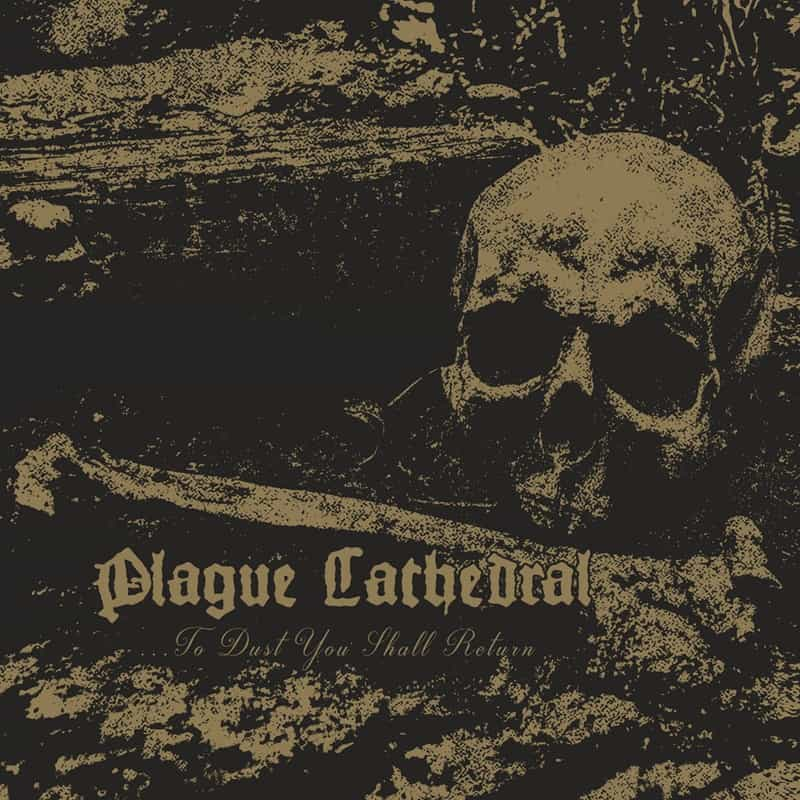
Artist: Plague Cathedral
Title: To Dust You Shall Return…
Label: Zazen Sounds & Cavsas (Cyclic Law)
Release date: October 26th, 2026
Country: Canada
Format reviewed: High-quality digital recording
#AlbumReview: Plague Cathedral – To Dust You Shall Return… via Zazen Sounds & Cavsas (Cyclic Law) by Pegah
The Experimental Industrial Doom metal band Plague Cathedral have released their debut album, “…To Dust You Shall Return”. This Canadian duo consists of Chris Undirheimar, responsible for vocals and lyrics, and Yves Allaire, who handles all musical compositions and artwork. The album revolves around death and the destruction brought by the plague, a disease that spread worldwide beginning in 1346 and continuing until 1353. Known as the “Black Death”, this devastating pandemic left a horrifying mark on its victims, particularly through the blackening of affected tissue.
Of course, we are no longer confronting this disease in the same way people did in the 14th century. Yet, as explored in Albert Camus’ “The Plague”, the epidemic can be interpreted as an allegory for totalitarianism, fascism, and the absurdity of human suffering and the seemingly meaningless nature of existence. More broadly, the plague can also be read as a metaphor for the corruption, decay, and overwhelming crises that continue to consume our world, making existence itself feel increasingly unbearable. Until now, the black death is shown as dominant, holding the power, until he confronts a human being who is not afraid of anything, maybe because he doesn’t have anything to lose.
The album opens with a crushing and imposing soundscape, evoking the image of two opposing forces: an army on one side confronting death itself on the other. At the same time, a voice chants about the inevitability of death. The atmosphere and soundscape of “Acerbitas Mortis” (Harshness of Death), accompanied by the haunting vocals, embody the merciless and relentless nature of death, lurking in the shadows and waiting for the right moment to hunt us down, one by one. There is no escaping its cold, powerful grasp. The next track, translating to “An Offering to the Crows”, portrays a condemned man awaiting his execution. Once again, the inevitability of death takes center stage, this time intertwined with the symbolism of crows, often associated with mortality and the guiding souls between realms. The soundscape remains haunting and unsettling, carrying an eerie atmosphere that lets the listener feel the chilling winds of darkness.
Through “Le Souffle Perfide du Néant” (The Treacherous Breath of Nothingness), both the atmosphere and the lyrics carry a heavier weight of darkness. There’s a shift from the fear of impending death to something much more existential: the speaker is already dead, or at least speaks from the threshold between existence and non-existence. In “Prague’s Orloj”, we are going to listen to the story of a clock located in Prague that dates back to 1410. Its original mechanism was constructed by clockmaker Mikuláš of Kadaň, working with astronomer and mathematician Jan Šindel. It is one of the oldest functioning astronomical clocks in the world. Unlike an ordinary clock, the Orloj displays astronomical information, including the positions of the Sun and Moon, alongside different systems of measuring time. According to the story, Prague’s councillors became afraid that he would construct an even more magnificent clock for another city. They therefore arranged to have him blinded so that he could never reproduce his masterpiece. In an act of revenge, Hanuš returned to the clock, damaged its mechanism, and caused it to stop working. The story says that the clock remained silent for years.
Finally, the time has come: “1346” marks the spread of the Black Death across the world. Death is no longer merely an approaching force or an abstract concept; it takes on a tangible form, becoming a character who speaks directly to a human being. The listener can almost feel the freezing breath of Death whispering into their ear, announcing the arrival of an inevitable fate. “L’ombre et Le Supplicie” (the shadow and the tortured) portrays a protagonist who is not simply afraid of dying. He seems to have lost faith in the very people and institutions that should have offered him compassion. Death becomes preferable to submission. Until now, the black is shown as dominant, holding the power, until he confronts a human being who is not afraid of anything, maybe because he doesn’t have anything to lose.
The closing track, “Un Fléau Sans Nom” (A Plague Without a Name), brings together almost every theme explored throughout the album: death, suffering, darkness, corruption, and the inevitability of destruction. It reflects an unending struggle, as the plague never truly disappears. We continue to be exposed to tyranny, cruelty, oppression, and suffering in our everyday lives. Perhaps the plague has simply changed its form, finding new ways to spread through a world that seems unable to escape its destructive nature. 8.5/10
Band
Instagram
Facebook
Bandcamp
YouTube
Label
Cyclic Law
Website
Instagram
Twitter
Facebook
Bandcamp
YouTube
Soundcloud
Label
Zazen Sounds
Bandcamp
Instagram
Facebook
YouTube
8.5/10 To Greatness and Glory!
**Please support the underground! It’s vital to the future of our genre**
#WeAreBlessedAltarZine
#TheZineSupportingTheUnderground