Releasing The Plague – Interview with Bahareh of Solistitium Records by Pegah
Hello everyone, this is Pegah from Blessed Altar Zine, and today I’m here to talk to Bahareh, the Managing Director of the German black metal label “Solistitium Records”. Originally from Iran and now based in Germany, Bahareh represents something particularly meaningful to me. Seeing fellow Iranians working as composers, musicians, or label managers is always a source of pride, but seeing women from my home country making their mark in the music industry means something even more special to me.
Hi dear Bahareh, thank you so much for accepting my invitation. I’d like to start with you and your personal journey. Could you tell us a little about yourself and what brought you to Germany?
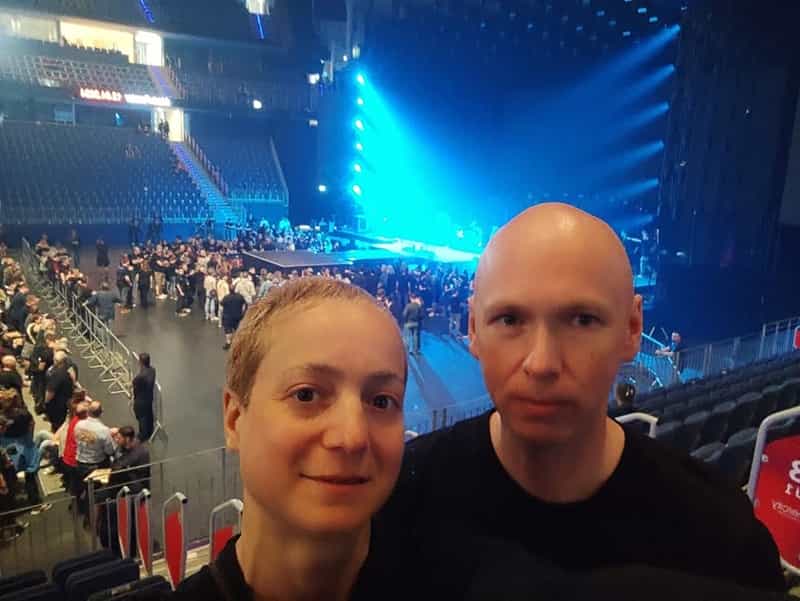
Hello Pegah, it is an absolute pleasure to connect to your readers, and I thank you so much for your interest. Allow me to introduce myself briefly. My name is Bahareh. I was born in Rasht (Iran), and lived in Tehran from 1984 until 2018. I worked at a small company that was specialised in repairing electronic control units (ECUs). While living in Iran, participating in sport, such as climbing mountains, riding bicycle, Pilates and TRX served as a vital anchor for me. Through my visits to and short stays in the Netherlands, since 2007, I realised that by nature I fit in here, in Northwestern Europe better than in my homeland. The decision to immigrate required a significant amount of time, and much changed during this period. I decided to settle in the Netherlands, because my sister lives there, but fate decided otherwise. I met Carsten; we got married, and I immigrated to Germany. Through this, a new chapter began in our lives which led to the revival of Solistitium Records.
Wow! Your life was pretty adventurous, now please tell us how your passion for metal music developed? As you know, the situation in Iran is quite different from many parts of the world, and metal music—especially in the past—was not as accessible. What was it like discovering metal in Iran, and did you ever imagine that one day you would be a Managing Director of a record label?
As a teenager, my personal taste of music was traditional music of Iran, whereas hearing my brother’s cassettes as he played them at home, I became familiar with other genres of music. To highlight some, I would say: Pink Floyd, Dead Can Dance, Scorpions, Judas Priest, Def Leppard, Metallica and Guns N Roses. There were no black metal bands among them, but rock, hard rock and thrash metal. I did not know black metal before I met Carsten. Understanding the bond between this genre and nature and mythology, it admiring isolation and its approach towards religion fascinated me. It felt like waking up from a nightmare, in which I have been lost and caught in a parallel world and finding me back in the world I belong to. Honestly speaking, it has been my dream to be self-employed, but I could not have pictured me in a million years as a managing director of a record label.
As the dream comes true, let’s talk about “Solistitium Records”. How did the label come into existence, and who was involved in its beginnings? What was the idea behind establishing the label?
Back in 1993, black metal record labels did not exist in Germany. Consequently, acquiring relevant CDs or LPs were difficult. This was the spark founding Solistitium and few other record labels at approximately the same period. Carsten was only eighteen years old when he established “Solistitium Records”, and he successfully directed company operations for nearly twelve years; with plenty of releases which many of them are still gems in black metal history. In 2005, Solistitium went out of business for twenty years, because it was not possible for Carsten to manage it aside from the main job. A true passion never dies; it remains alive in our hearts waiting for a chance to rise. I refused to let this passion remain a dormant ideal. So we started with legal process of registering Solistitium Records before the end of 2024.
That’s an interesting journey! So, when you receive music from an artist, what makes you want to work with them? Are there any particular qualities you look for when selecting artists and releases for the label?
As currently, there are so many bands and projects in the underground scene, uniqueness of a band together with it having an established history constitute the most persuasive factors to us. From time to time, we receive submissions that we attempt to respond to painstakingly; considering other important elements alongside music. In recent time, grow and evolve potential of a band is not only dependent on its distinctiveness and expertise, but also on it performing live and be active on social media. It is also equally essential, if a band possesses an established support and have theatrical acumen. We realised that we can effectively manage the current crisis only with minimising risks by building and committing to permanent structures, and our decision to cooperate with a band must be predicated on that.
Running an independent underground label certainly comes with its own challenges. What have been some of the biggest obstacles you have faced along the way, and how have they shaped the way you run Solistitium Records?
Unfortunately, we live in a world that encourages people to be consumers, but neither be productive nor providers. Bureaucracy, legislation, and tax obligations create market barriers by for example, increasing operational costs, draining resources, and slowing down business growth. Moreover, rise of inflation leads to higher costs for a business, and declining interest for people who support bands and labels by purchasing physical copies of releases. This is how I interpret the considerable reduction of request, that is extending; which could be one among a couple of reasons, or even wrong. Moving to another topic, I would like to point out to artificial intelligence. It is quick, cheap, and almost everyone can create a complete album with having limited knowledge about art and music. Although the majority in the metal scene are against it, it has infiltrated this segment, as it has everywhere else. It is not always easy to distinguish between original and fake, and sadly, progressively it is acquiesced by few. AI’s implementation is primarily disrespectful to the true talent, striving, and dedication of genuine artists, and secondly to the entire community. In conclusion, we are compelled to effectively control the costs, and meet stringent criteria for artist selection.
At the same time, the world has been facing a global crisis, and Iran has gone through some particularly difficult events, from the events of January to the war that followed. These developments have had a significant impact on many people, both inside and outside the country. As someone with roots in Iran, did the situation affect you personally during that period? And did it have any impact on your work or your connection with the Iranian metal scene?
Anyone who has been for some reason engaged with Iran and its political landscape knows that brutal events of January 2026 were undeniable evidence of the government cruelty for the whole world. However, it has not been an uncommon approach by the Islamic Republic. The regime has been both repressing and suppressing any ideological and political oppositions, uprisings, and revolts since it came into power, exactly by exploiting all the parties in 1979, in order to take control over the country. As someone with roots in Iran, I suffered as people in Iran did, in a different way, but not less than them. I can write a chapter of a book about what I went through with the emotional rollercoaster during and after the complete blackout, not knowing about what is going on, not being able to do anything in order to help people there. At Solistitium, Carsten and I take different tasks on, according to our capability and skills. Everyone knows him as the man behind “Solistitium Records”, and he has extensive experience in the scene, and proficiency in bureaucratic procedures, etc. Nevertheless, we work as a two-person team. While I had to struggle hard to stay just a little focused, we were receiving orders as usual; we had to create contents for social media, for example, to promote our bands as is customary, and so forth. The world turns further, and one cannot expect much understanding for personal problems from those who are involved. Sadly, there were people who followed both our business profile and my personal account on instagram that stopped supporting the record label after I posted about the ongoing brutality in Iran, and I did never expect it.
I’m really sorry for what you’ve been going through. I totally understand you, these are still difficult times for Iran, but life has to go on, even when the world around us feels uncertain. We can only hope that these dark days will come to an end soon. Moving on to your journey, you have built your career within the European underground metal scene while coming from Iran. Has your Iranian background influenced the way you approach music, the artists you work with, or the way you run Solistitium Records? Do you feel that it gives you a different perspective on the underground scene?
If me originally coming from Iran has directly affected my approach towards music or not, I do not think so. However, unconscious influences cannot be ruled out. Iran has a rich, independent mythology with deep historical roots, mythical creatures -for example “Simorgh”, which is often mistaken for Phoenix- and much more. Overall, it offers immense dark potential for black metal music. There are plenty metal bands from different genres that favoured it, such as From The Vastland, that have recently released a new album titled Servant of Ahriman. I must point it out that it would be an honour for me personally to have collaborations with metal bands based in Iran or with Iranian members, so that we can have a better chance together, to introduce Iranian folklore, culture, and history to the metal community.
It would be wonderful if we could come together as a community to nurture this passion and spread its spirit to a wider audience. With that in mind, from your perspective, how has the underground metal scene changed in recent years? What do you think are the biggest challenges facing independent labels today, and where do you see opportunities for them to grow and reach a wider audience?
Realm of music is international, without geographical borders, which makes it quite impractical by many factors. Politic with sanctions and every now and then new custom laws, which makes both attending a festival and delivery of parcels difficult; taxes and bureaucracy, economic expansion, etc. It is a never ending list. There come always heavy waves that with them some are condemned to disappear, either forever, or for a short while. They can be ripe of opportunity as well, only if one does not attempt to stick to habits and resist the change, which is usually not easy. For example, during the COVID-Pandemic with prohibiting live performances, request for physical copies and digital releases arose, but it changed as the pandemic ended. Social media with its power to bring one in attention or push them in shade has been another challenge, especially for many in the underground metal scene. For the time being, a new obstacle has been encountered; concerts are either being cancelled, or held before a sparse audience; and request for physical copies has drastically fallen. It is no secret that people who are in a way active in the underground, no matter musicians, record labels, or even reviewers do what they do only and only out of passion with zero material expectations. On the other hand, it demands much time, energy, and money to produce an excellent piece of work, within everyday rising standards; and I wonder, what could be the solution this time, to keep the dark flame burning; under circumstances that the majority of audience disregard, or perhaps overlook their own share in the scene. Sometimes creativity and innovation are the way out of crisis, sometimes one needs to be patient, and sometimes one has to accept that there is no solution to find or make.
Unfortunately, I think you’ve touched on some very real challenges facing the underground metal scene. Looking ahead, what would you like Solistitium Records to become? Are there any particular directions you’d like to take, artists you’d like to work with, or projects you hope to explore in the coming years?
“Solistitium Records” was founded and is known as a black metal label and it will be. However, we would like to expand our limits and include bands from other genres, namely death and doom metal. Undoubtedly, it would be a pleasure to have renowned bands on the roster of the record label, and a higher honour to advance bands’ career through us. We aim to strive to highlight our artists’ massive potential within the community, and it is our responsibility. Furthermore, to manage and go on European tours with our bands is an aspiration of ours.
I hope all your plans come to fruition in the near future! Thank you again, dear Bahareh for taking the time to speak with us. Before we wrap up, is there anything else you’d like to share with our readers?
Dear Pegah, I greatly appreciate you taking the time, and offering me the chance to speak about my motherland. Thank you everyone for reading and meeting with the so far dark side of “Solistitium Records”. We fight to keep the black flame in underground not only alive but blazing!
Label
Website
Instagram
Instagram (Private)
Facebook
Bandcamp
YouTube
**Please support the underground! It’s vital to the future of our genre.
#WeAreBlessedAltarZine
#TheZineSupportingTheUnderground